

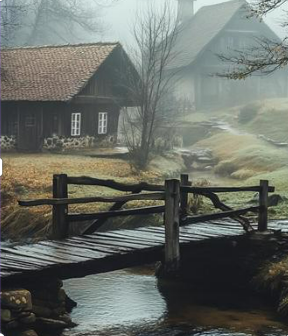
Marrow’s End had no cathedral, no temple, no shrine. It had a bridge—old, wooden, and worn by time. It stretched across the river like a whisper, connecting two halves of a town that had forgotten how to hope.
Every morning, Elias crossed it. He was seventy-three, with hands like cracked leather and eyes that had seen both miracles and mourning. He wore the same coat every day, patched at the elbows, and carried a satchel filled with bread, matches, and a small Bible.
No one asked why he crossed the bridge. No one asked what he prayed for. But Elias believed God still walked the riverbanks. He believed that even in silence, God spoke. That even in ruin, God rebuilt. That even in Marrow’s End, where the mines had dried and the fields had withered, God had not turned away.
Each morning, Elias sat beneath the old willow on the far bank, opened his Bible, and read aloud—not to anyone in particular, but to the wind, the birds, and the river. “Faith,” he would say, “is the substance of things hoped for, the evidence of things not seen.”
One winter morning, he found a girl beneath the willow. She was no older than ten, wrapped in a coat too thin for the cold, her cheeks red and raw.
“Cold morning,” Elias said gently. She nodded but didn’t speak. He sat beside her, pulled bread from his satchel.
“Hungry?” She hesitated, then took it. Her hands trembled.
“What’s your name?” he asked.
“Lina,” she whispered.
“Where’s your family?”
She looked away. “Gone.”
Elias didn’t press. He simply opened his Bible and read: “When my heart is overwhelmed, lead me to the rock that is higher than I.” Lina listened. She didn’t understand all the words, but something in them felt warm. Every day after, she met Elias at the bridge. They fed the birds, watched the river, and read scripture together. Slowly, she began to smile. She began to speak. She began to believe.
Spring came late that year, but when it did, the willow bloomed. Elias brought seeds and showed Lina how to plant them. “The earth remembers,” he said. “And so does God.” They planted sunflowers, beans, and wild mint. Lina laughed when the sprouts broke through the soil. She danced when the birds returned. She sang when the river ran strong.
Others began to notice. Ruth, who had once run the bakery, started leaving loaves on the bridge. Tomas, whose father had vanished in the mines, began painting the railings with bright colors. Harun, who hadn’t spoken in years, began carving wooden benches for the willow grove. Marrow’s End stirred. Not all at once. Not loudly. But like embers catching wind.
One day, Lina asked Elias, “Do you think God still remembers this town?”
Elias smiled. “God never forgot. We did.” She nodded. She understood.


7 thoughts on “The Whisperer of God”
I think this is one of those stories where you can’t congratulate the author even if you want to, you just have to sit and meditate upon the message.
I agree. It’s such a well written story and powerful at the same time. Beautiful.
yeah you have to be still
I agree
Hey, I hoped you liked it, part two coming soon!
Ooh, there’s a part two!!
I have a question in the discussion how do you find the discussion you commented in?ps really like this story