

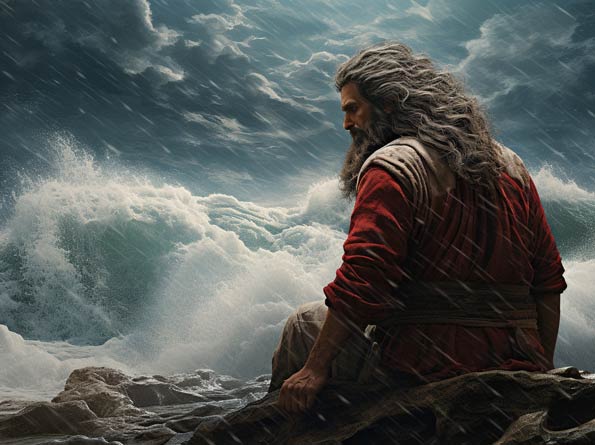
Chapter I — The Night the River Listened
No one saw the river change its mind.
The Nile had always taken what it was given. Blood, reeds, bodies—it swallowed all without memory. Yet on one moonless night, when Egypt slept and fear walked the streets like a second patrol, the river hesitated.
A woman stood at its edge.
Jochebed had already lost her voice from prayer. The gods of Egypt did not answer, and the God of her fathers answered only with silence. In her arms lay a child who did not cry. His eyes followed shadows, as if he were listening to something older than the stars.
“They are killing sons,” Miriam whispered behind her.
“I know,” Jochebed said.
She placed the child into the basket not as surrender, but as defiance. She sealed it with pitch, as if daring the river to break it. When she released it, the water closed gently around the reeds.
And for reasons no one could explain, the current did not pull him under.
Far downstream, Pharaoh dreamed of a throne cracking in half.
Chapter II — The Child Who Did Not Belong
The palace was built to keep the world out.
Yet the child brought the world with him.
Pharaoh’s daughter found the basket at dawn, the mist still rising like ghosts from the river. When the baby cried, it was not hunger she heard—but accusation.
“This one should be dead,” a servant murmured.
“So should many things,” the princess replied.
She named him Moses, though the name felt older than her language, older than Egypt. As he grew, strange things followed him. Animals watched him too long. Fires bent away from him. He asked questions no tutor could answer.
“Who am I?” he asked once.
“You are mine,” the princess said, and yet she never sounded certain.
At night, Moses dreamed of water closing over him, and a voice beneath the surface whispering his name.
Chapter III — The Secret in the Sand
Truth has a way of bleeding through stone.
Moses learned it the day he saw an Egyptian overseer strike a Hebrew slave. The blow landed, and something inside Moses shattered. The world narrowed to breath and heartbeat.
He struck once.
The overseer fell.
The sand swallowed the body, but it did not swallow the guilt. The next day, two Hebrews argued, and one spat at Moses:
“Who made you judge over us? Will you kill us too?”
That night, Moses understood: Egypt would never claim him, and his own people did not trust him.
Pharaoh already knew.
Before dawn, Moses fled. The palace did not stop him. It was as if Egypt itself was relieved to let him go.
Behind him, a throne waited patiently for revenge.
Chapter IV — The Years That Erased His Name
The wilderness does not care who you were.
In Midian, Moses became no one. Shepherd. Stranger. Husband. The years wore him down until his reflection no longer accused him.
He stopped dreaming.
Then, one afternoon, he saw fire.
A bush burned on the mountain, but the flames did not consume it. They folded inward, alive, waiting. Moses stepped closer, and the mountain breathed.
“Moses.”
The voice did not echo—it existed everywhere at once.
“I have seen what is hidden,” the voice said. “I have heard what is silenced.”
Moses fell to his knees. “Why me?”
“Because you ran,” said the fire. “And because you returned.”
When Moses asked the name of the One speaking, the answer came like a riddle wrapped in thunder:
“I AM.”
Nothing more. Nothing less.
Chapter V — The Signs That Terrified Kings
Pharaoh remembered Moses the moment he saw him.
The staff turned into a serpent. The Nile rotted. Darkness swallowed the sun. Egypt’s gods failed one by one, exposed as masks with nothing behind them.
Still Pharaoh resisted.
With every plague, something ancient watched. The air grew heavy, as if the world itself waited for a verdict.
On the final night, death passed through Egypt like a whisper no door could shut. By morning, the empire screamed.
“Go,” Pharaoh said, broken. “Before you destroy us completely.”
Yet even as the Hebrews fled, the sea waited.
At its edge, trapped between water and chariots, Moses raised his staff. The wind howled. The sea split—not like a miracle, but like something remembering an old command.
When the waters closed again, they closed with finality.
Egypt vanished behind them.
Chapter VI — The God Who Hid in Fire
Freedom was colder than slavery.
The people doubted. They accused. They feared the silence. At Sinai, the mountain burned as if the earth itself were being judged.
Moses climbed alone.
Within the cloud, time unraveled. God spoke in law, in fire, in warning. Stone received words that could not be erased.
But below, the people melted gold into a god they could touch.
When Moses returned, the betrayal struck harder than any blade. He shattered the tablets. The sound echoed like a covenant breaking.
Yet God did not leave.
“Carve new stone,” the voice said. “And come again.”
Mystery returned to mercy.
Chapter VII — The Leader Who Could Not Enter
Years passed like dust.
Moses carried a nation that did not understand him, and served a God no one could fully see. He spoke with the divine, yet never possessed it.
Once, in anger, he struck the rock when he was meant to speak.
That single moment echoed louder than forty years of obedience.
“You will see the land,” God said, “but you will not cross.”
From Mount Nebo, Moses looked upon the promise. He did not weep. He understood at last.
Some are chosen to arrive. Others are chosen to open the way.
When he died, no one saw it happen. No grave was marked. No body found.
Only the wind moved strangely over the mountain, as if something unseen had just passed.
Epilogue — The Man Who Never Left
They say Moses died.
Yet his voice returns whenever chains are broken.
His shadow stands wherever power is challenged.
His story refuses to stay buried.
A child saved by water.
A man shaped by fire.
A mystery who spoke with God—and vanished.
And somewhere, beyond sight,
the river still remembers him.


1 thought on “Moses The Conducter to the Promised land”
I am in awe at this writing! This is such an amazing story.